





Efling members can get free tickets to the album release concert of the band Grýbos at Tjarnarbíó on September 24. Tickets are free of charge and can be picked up at the reception desk at Efling Union’s office at Guðrúnartún 1, 3rd floor. There are only 25 tickets available, so members are encouraged to act quickly. Tickets are available on a first-come, first-served basis. Each Efling member can receive two tickets while supplies last. The concert is held to celebrate the release of the album Kemur í ljós. Grýbos is a musical project by brothers Alexander and Jakob Grybos, joined by Hlynur Sævarsson on bass, Magnús Már Newman on drums, and Guðjón Steinn on various instruments. The concert starts at 8:00 p.m.
Eflingarfélögum bjóðast miðar á útgáfutónleika hljómsveitarinnar Grýbos í Tjarnarbíói 24. september næstkomandi. Miðarnir eru án endurgjalds og sækja þarf þá í afgreiðslu skrifstofu Eflingar stéttarfélags í Guðrúnartúni 1, 3. hæð. Miðarnir eru aðeins 25 talsins og því um að gera að hafa hraðar hendur. Fyrstur kemur, fyrstur fær. Hver Eflingarfélagi getur fengið tvo miða á meðan birgðir endast. Tónleikarnir eru, sem fyrr segir, útgáfutónleikar sem haldnir eru í tilefni af útgáfu plötunnar Kemur í ljós. Grýbos er tónlistarverkefni bræðranna Alexanders og Jakobs Grybos en með þeim spila Hlynur Sævarsson á bassa, Magnús Már Newman á trommur og Guðjón Steinn á hin ýmsu hljóðfæri. Tónleikarnir hefjast klukkan 20:00.
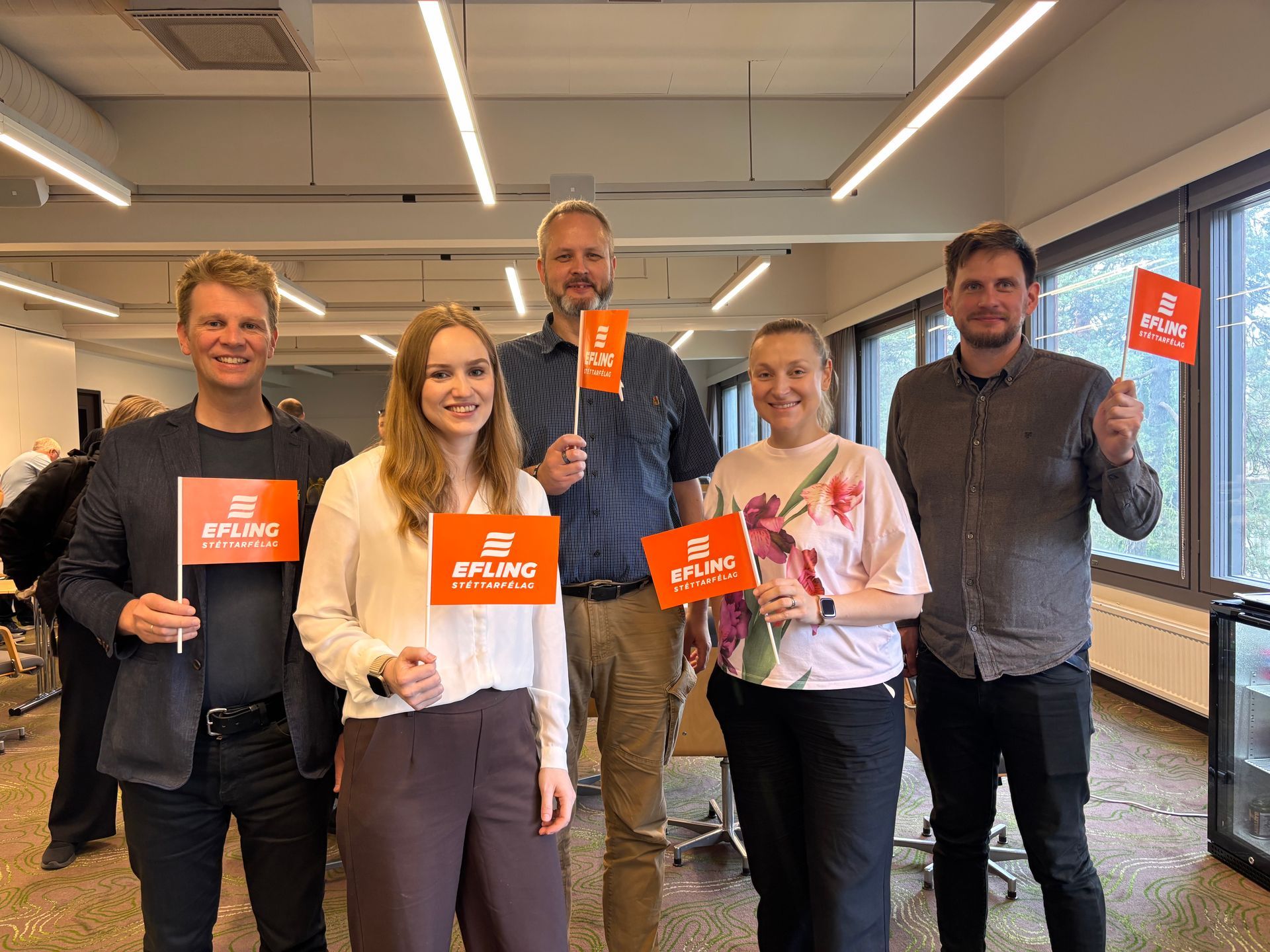
A delegation from Efling participated in a Nordic conference of security guard unions in Korpilampi in Finland during September 14-17. The conference brought together members, union reps, staff, and leadership of the unions, all of which are members of the federation SUN. Sectoral conferences of this kind are held every other year and the member unions take turns hosting them. The program began on Monday afternoon with inauguration and so-called country reports, where representatives from each union went over the state of affairs in the economy, bargaining, and politics in their home countries. On Tuesday, the program began with a presentation on a detailed comparison of security guards’ collective agreements in the Nordics. Most of the work going into the comparison was undertaken by Efling, with the presentation delivered by Efling staff member Eleonora Maximciuc. On the same day, technological developments in the guard sector, including AI, were discussed, and three scholars from the Nordics gave presentations on research relevant to the sector. Viðar Þorsteinsson, director of education and membership affairs, lead a panel discussion with the presenters. The Wednesday program began with a presentation from Adam Fishwick, adjunct professor at the University of Iceland, where he showcased his research on union renewal. His research project focuses on Efling Union. After that, Mark Bergfeld from UNI Europa gave a talk via videolink on work being undertaken at the European level to protect guards’ rights. In the afternoon, participants went on a sightseeing trip to the historic Sveaborg – Suomenlinna fortress just outside Helsinki. The final topic of the conference, on Thursday morning, was the organization of security guard training and certification in the Nordics, with each union giving a detailed presentation on the requirements of the respective country regarding the profession’s vocational training. Viðar Þorsteinsson and Sigrún Björg Guðmundsdóttir, vocational training officer at Efling, delivered a presentation on Efling’s behalf and participated in discussions. In the conference’s discussion of vocational training, it came clearly to light how far ahead of Iceland the other Nordic countries are in this area when it comes to the security guard professions. All the Nordic countries except Iceland make demands to security guards for certain training and education, which are generally found in legislation. Furthermore, the parties to the labor market have worked closely together on developing course curriculums and training certificates. Sweden is among the leaders, where the union Transport has along with the employers’ federation set up a major institute, BYA, which handles all vocational training matters and other professional matters of the sector. Multiple opportunities were created for communication and networking during breaks, common meals, and other informal shared time. It is no exaggeration to say that Efling staff and leadership returned home from the conference with rich resources in the form of knowledge, connections, and useful information about existing models when it comes to professional development in the guard sector. The next task for the union is to build on this work in dialogue with guards themselves, their companies, training providers, and the government. The Efling delegation at the conference was comprised of the following individuals: Atli Antonsson, project manager in membership affairs Eleonora Maximciuc, advisor in labor rights Sigrún Björg Guðmundsdóttir, vocational training officer Viðar Þorsteinsson, director of education and membership affairs Þórir Jóhannesson, vice chairman of Efling and union rep of dockworkers at Samskip The unions represented at the conference, in addition to Efling, were the following: Norsk arbeidsmandsforbund (NAF) from Norway. NAF also represents cleaners, and Efling has collaborated with the union’s cleaning division at SUN level VSL from Denmark. VSL only bargains for security guards, and is the only dedicated security guard union in the Nordics. PAM from Finland. As with NAF, PAM negotiates also for cleaners and is a member of the SUN cleaning branch. Transportarbetareforbundet from Sweden, commonly referenced as Transport. The union makes collective agreements for truck drivers, dockworkers, and other professions in the transportation field.