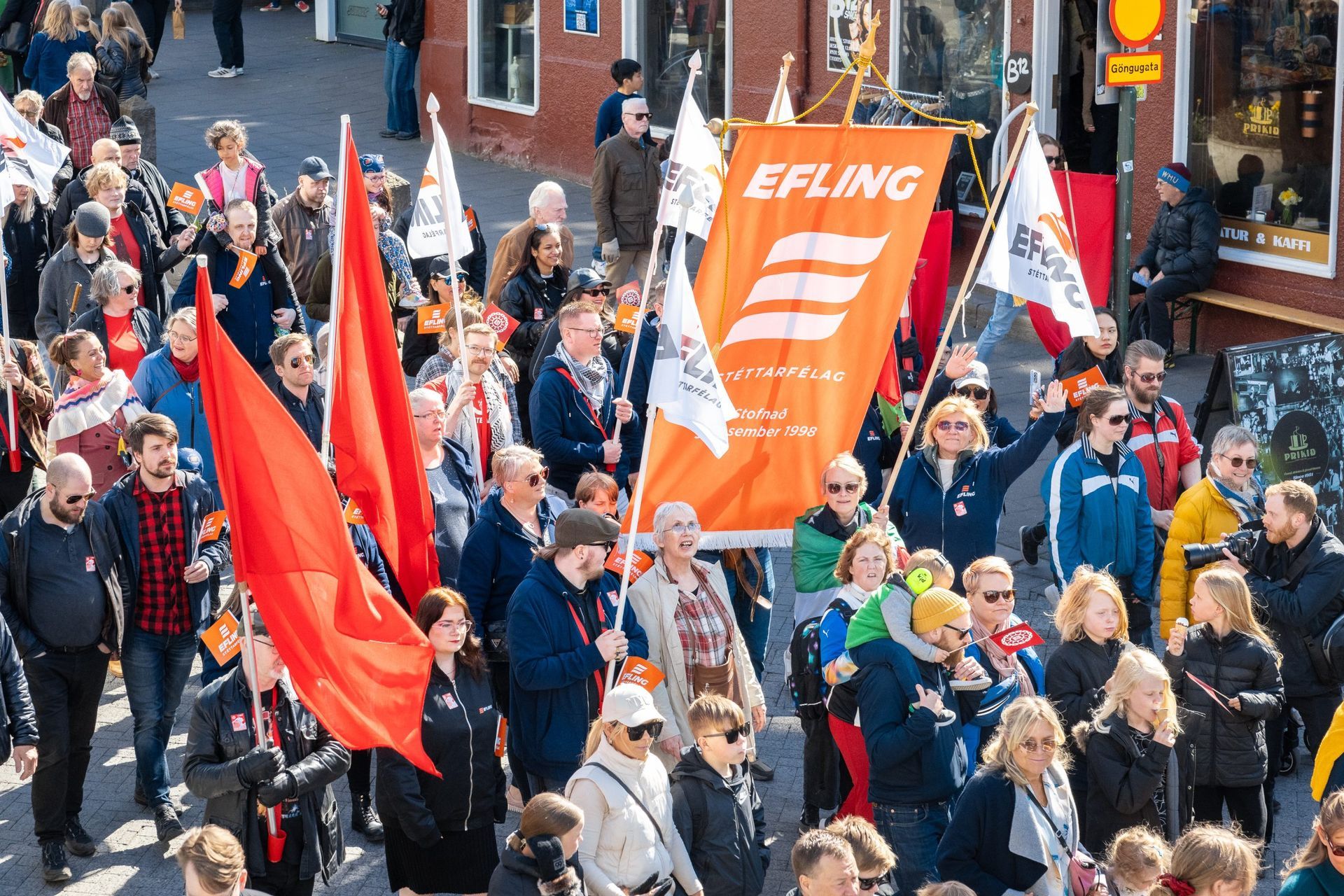
There is currently much discussion about the need to change the Icelandic labour market model, that is, the organisation of labour market affairs and collective bargaining. This is said to apply whether or not Iceland joins the EU.
I will not, however, discuss EU membership here, but rather examine the advantages of the current labour market model in Iceland from the perspective of working people.
Why do people want to change the labour market model?
The main arguments put forward for the need to change the labour market model are said to be that wages have become too high in Iceland, that the influence of the trade union movement is too great, and that there is a lack of common signals indicating the scope for wage increases. Wages are therefore said to be rising excessively relative to companies’ ability to pay and productivity growth. It is also argued that it is too easy to use strike action as a means of exerting pressure, leading to its misuse, including to force through excessive wage increases.
If all of this were true, one would expect companies in the country to be under particular strain. It would be difficult for them to operate profitably, generate economic growth, and create new jobs. There are, however, no indications of this.
Living standards are high, company profits are generally substantial, innovation is active, and companies create far more jobs each year than can be filled by the country’s domestic population. This has led to a need to bring in thousands of foreign workers every year; in practice, many more than the country’s infrastructure can cope with. The Central Bank also says that unusually high interest rates are needed to cool the economy, which is considered too strong and is creating excessive demand that fuels inflation. Many other points could be added.
I believe that all the above claims about the need for a changed labour market model are wrong.
- Wages are not unreasonably high here, when measured against the living standards of Icelandic society and the performance of the economy
- The trade union movement represents around 90% of working people and therefore does not have an unreasonably strong influence
- Common signals indicating the scope for wage increases are regularly established in collective agreements, although the extent to which they are subsequently adhered to varies. Employers are most often responsible for failures in this regard, through substantial wage drift on top of the increases stipulated in collective agreements.
- Wages generally do not rise in collective agreements beyond companies’ ability to pay.
- Wage increases have now had relatively little impact on inflation
- There are considerable restrictions on the use of strike action, and these are generally respected by the movement.
- The activities of the State Mediator and the Labour Court are generally effective in resolving disputes.
- The trade union movement has generally acted responsibly in recent years.
Indeed, there are strong arguments for saying that the Icelandic labour market model is the best known in the world from the perspective of working people. Nor does it disrupt the normal and prosperous functioning of the economy. In fact, the Icelandic trade union movement has played a major role in shaping good living standards and a good society in Iceland, under the protection of the Icelandic labour market model.
In this article, and in others that will follow, I will present strong arguments in support of this conclusion.
What does the Icelandic labour market model entail?
The most important characteristic of the organisation of the labour market in Iceland is the exceptionally high level of participation by working people in trade unions, in fact, the highest among OECD countries. This creates an important role for the movement in shaping living standards and society. It is one of the most important foundations for the strength that the movement can mobilise when it matters.[i]
The movement has a strong organisational structure of occupational unions throughout the country, such as unions representing manual workers, tradespeople and professionals, as well as industry-based unions, such as unions representing retail and office workers. Collective bargaining rights rest with individual unions, which means that members throughout the country must approve the outcomes of collective agreements, each occupational group or industry separately.
The movement also has umbrella organisations that can mobilise broader solidarity where appropriate and, in particular, take action on matters relating to collective bargaining policy in society, as well as cooperate with employers’ organisations and the government between rounds of collective bargaining, during periods of peace. The most important of these are ASÍ, BSRB and BHM, which operate in different sectors of society. This organisational structure is similar to that found in the other Nordic countries.
Employers’ organisations are centralised and very powerful actors in representing the interests of companies. They in fact have greater resources for exerting influence than workers’ organisations, both financially and organisationally, as well as through the media. It is therefore important that the trade union movement can act with strength and sound judgement on behalf of working people, in order to counterbalance the considerable influence of employers’ organisations.
Working people must therefore oppose any changes to the organisation of labour market affairs that weaken the trade union movement, although there is considerable interest in such a weakening on the political right and among employers and market-oriented economists.
The trade union movement also has important roles in protecting and developing workers’ rights and general working conditions, as well as in education and training. It is also very important that the trade union movement generally places strong emphasis on welfare considerations in the economic and collective bargaining policies of society, which has strengthened the welfare state in certain areas.
It is important to bear in mind in this context that strong consumer spending by working people is a major driver of economic growth, indeed a vital source of energy for the operations of companies, although employers tend to overlook this.
Neoliberal politics, which has been influential in recent times, has repeatedly undermined the welfare state and the trade union movement and has sometimes succeeded, for example with the abolition of the social housing system in 1999. In that case, the trade union movement should have defended it much more forcefully than it did. Since then, developments in housing have consistently taken a turn for the worse and undermined the modest improvements in living standards that collective agreements were intended to deliver.
The Icelandic labour market is characterised by a considerable degree of regulation, while at the same time providing companies with substantial flexibility to adapt their workforce to their own needs and to fluctuations in circumstances, more so than is generally the case in continental Europe. It is therefore relatively easy to dismiss employees in Iceland during periods of economic contraction, while the movement has, in return, placed strong emphasis on ensuring that working people receive good unemployment benefits while between jobs or during periods of crisis.
The rental housing market is another example of a market where regulation is limited in Iceland, leaving tenants poorly protected against insecure housing and rent increases. The trade union movement needs to act more forcefully in this area, establish appropriate regulation and rein in rent increases, which are generally excessive.
The tasks involved in defending the interests of working people are therefore endless, and nothing can be conceded when it comes to the strength or position of the movement.
Developments elsewhere
Internationally, trade unions have been weakened in many places. This is due to neoliberal politics, globalisation and opposition from employers. Fortunately, the Icelandic trade union movement has largely withstood such destructive forces, and this is an important reason why Iceland has been more successful in resisting negative developments in living standards than many other Western countries.
A significant part of the equality that exists in Iceland’s income distribution can also be attributed to the trade union movement. This has taken place under the protection of the Icelandic labour market model. I will demonstrate this in a later article.
The Icelandic labour market model therefore has major advantages, both for working people and indeed for society as a whole. The organisation of labour market affairs here is not, however, set in stone. It can be fine-tuned to evolve with society. But this requires full consultation with the movement and must in no way weaken its ability to exert influence.
It would generally be more appropriate to curb employers’ scope to add wage drift on top of the increases stipulated in collective agreements, rather than to limit the influence of the trade union movement.
In public debate, the trade union movement is often blamed for some of what goes wrong in economic policy, for example, the struggle against inflation and the shaping of conditions for economic growth. But it is easy to demonstrate that wage increases agreed through collective bargaining generally have little impact on inflation and, in fact, that good wages and conditions for working people improve the conditions for economic growth in the country.
Mariana Mazzucato, a respected economics professor at University College London, has recently published a report with her colleagues on the causes of weak economic growth and productivity growth in Europe in recent times (see
here).[ii] The report concludes that for decades, discussions about insufficient economic growth and inadequate investment in production and innovation in Europe have generally blamed excessively high labour costs for companies. The main economic policy response has consequently been wage restraint and deregulation, and often the weakening of trade unions.
There has, however, been more than sufficient supply of cheap capital, and company profits have generally been substantial, both in Europe and in Iceland. In Europe, this has not translated into increased investment in productive activity, but rather into increased financial activity by companies, the accumulation of assets and increased dividend payments to owners. The share of value created going to working people has declined in many places as a result of wage restraint. Working people are thus blamed for inadequate economic development when the responsibility lies primarily with company managers and owners, the report states.
Those who want to change the labour market model in Iceland often use these same arguments when discussing economic policy problems in Iceland. Their main aim is to reduce the share going to working people and increase the wealth and profits of those who already own the most. Working people therefore need to remain vigilant.
The labour market model is and will remain one of the most important factors ensuring good and improving living standards for ordinary working people in Iceland, whether or not we join the EU.
Stefán Ólafsson is Professor Emeritus at the University of Iceland and works as a specialist at Efling
[i] I have discussed the characteristics of the Icelandic labour market and the importance of the trade union movement in shaping living standards and society in Iceland in detail in my recent book,
Baráttan um bjargirnar*: Stjórnmál og stéttabarátta í mótun íslensks samfélags* (University of Iceland Press, 2022).
[ii] Part of the summary of the findings of the report by Mazzucato and her colleagues can be found here: "Executive Summary: Europe has misdiagnosed its competitiveness problem. For decades, policy has treated the cost of labour as the binding constraint and prescribed wage restraint, flexibility and deregulation. Yet the European economy of the past two decades is one in which capital has been abundant and cheap and corporate profits strong, while investment, productivity and wages have stalled – something a diagnosis fixed on the price of inputs cannot explain. The binding constraint on growth and productivity is not the cost of labour but the direction of capital. When the profits of Europe’s largest firms are reinvested in production, innovation and employment, capital does its job; when channelled instead into financial assets, shareholder payouts and balance-sheet accumulation, it is misdirected. The damage that follows is the social cost of misdirected capital: a private gain to shareholders, paid for by workers, the public purse and the productive base itself." (Labour Squeezed, Investment Stalled*: The Hidden Cost of Financialisation in Europe’s Corporate Sector*, p. 5).