12. febrúar 2026

The emergency department is bleeding out – Staff demand immediate action

Dagsetning

12. febrúar 2026

deila

The safety of staff and patients at the emergency department of Landspítali in Fossvogur is constantly at risk. It is not possible to guarantee infection protection, fire protection or privacy. Staff and patients are therefore in circumstances where the risk of infections, accidents, violence and other serious incidents is obvious and ongoing. This situation has been evident for years but has been ignored by health authorities. Action must be taken now, otherwise the consequences of previously unknown and terrible scale will occur.


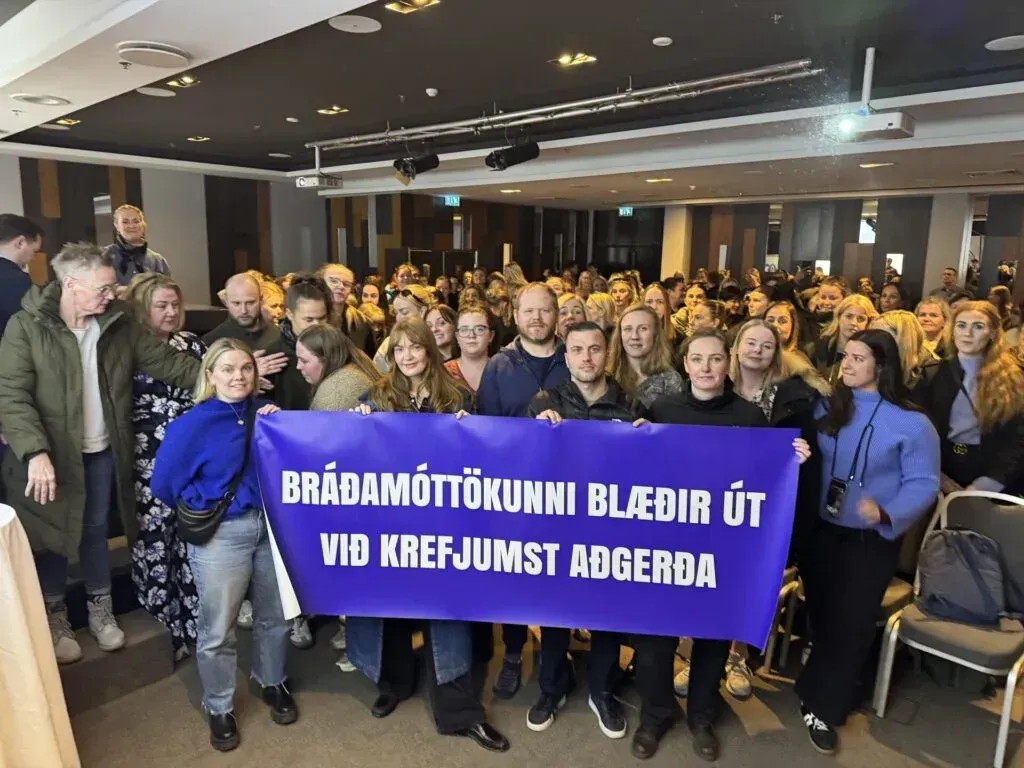
This is among what was presented at the joint meeting of the staff trade unions of the emergency department that was held on Wednesday, February 11. Present at the meeting were the Efling union, the Icelandic Nurses Association, the Icelandic Medical Association, the Icelandic Hospital Workers' Union and Sameyki. A huge crowd attended the meeting, about 180 people, and the sound was heavy among the people.


At the meeting the staff of the emergency department described the circumstances in such a way that no one who was listening should be distracted by thoughts that an emergency situation was occurring there. The department's response capacity is limited due to the large number of admitted patients there, who should be transferred to the appropriate wards in the hospital. Staff described fatigue, anxiety, sorrow and anger about the circumstances, as well as pride, solidarity, and a desire to be able to do their work in humane conditions. The demand is that until the municipal authorities respond to the information we previously provided about the situation and instead make improvements, for the benefit of staff, patients, relatives and society as a whole.


The fund approved unanimously, with a strong parliamentary resolution in which the situation was described and demands for actions were presented. The resolution can be read below. 


Resolution of the meeting of the strike action committee of Landspítali

11. February 2026


The conditions in the emergency department of Landspítali in Fossvogur are so serious that every day they threaten the safety of patients and staff in the emergency room and in an unmanageable danger. This has long been public and recognized by the hospital's management, the office of the chief medical officer and health authorities, without any satisfactory response being taken. 


The daily number of admitted patients far exceeds what the premises, layout and safety systems can tolerate. The consequence is that neither patient safety nor staff safety, adequate infection control, fire protection or privacy can be ensured. The hospital has been at the highest state of readiness for more than a full year without the health authorities responding. The inaction reflects the lack of resources and the shortcomings that the State Audit has pointed out. 


The Director of Health confirmed in a memorandum on June 2, 2022 that the emergency department did not meet professional requirements due to bottlenecks, an excessive number of patients and understaffing, and that it was impossible to ensure patient safety or service quality. The Director of Health said at that time that it would actually be most appropriate to close the department because of danger and unacceptable conditions, but also acknowledged that this would not be a realistic option since the department is the only one of its kind in the country and provides essential services. 


These serious statements from the Director of Health were ignored. Since then the situation has not improved, but has worsened. 


Over 100 patients are on average being housed in a space designed for 36. Isolation is impossible, restless or unstable patients are not guaranteed safety and oxygen cylinders together with other equipment are like raw material on the corridors of the emergency department with obvious fire and explosion risk. This is a serious safety threat for staff and patients, and with this number of patients the working conditions for staff are completely unacceptable.


The emergency department has for a long time been caring for admitted patients who should have been taken to the appropriate wards. It is not the role of the emergency department to run a duplicate ward on top of emergency services. This hampers the emergency department's response capacity and prevents staff from having the space and peace to perform their statutory duties in the reception and treatment of the injured and critically ill.


Staff were forced to work in conditions that go against their professional knowledge and recognized standards for good and safe health care. Such a situation is unacceptable and has lasting and negative effects on staff and the quality of service. 


Staff and patients are placed in situations where the risk of infection, accidents, violence, and serious consequences is obvious and ongoing. 


In December, eight employees were found with concealed weapons. This underscores the consequences of infection control and equipment not being in compliance with laws and regulations. Inaction in construction and investment in health facilities has created a systemic problem that now appears in a clear and dangerous manner in emergency care. 


We demand that the workplace complies with laws on health practices, safety and equipment and that immediate action be taken because there is a persistent and worsening emergency situation and we must already respond.


We also demand that those parties who bear legal responsibility respond immediately and follow up on the comments, inspections and committee findings that have previously been presented:


  • The Office of the Director of Health should follow up on improvements after being delayed when they assessed the department's conditions.
  • The Labour Inspection Authority conducts a comprehensive inspection of staff equipment and responds to violations of occupational safety laws. 
  • Health supervision takes into account circumstances regarding health conditions and infection prevention. 
  • Fire safety inspection follows its own assessment of fire risk due to oxygen equipment and fittings. 
  • Data protection can assess the circumstances with regard to the privacy and protection of patients. 
  • Health authorities conduct an assessment of injuries and mortality of patients with regard to length of stay in emergency care.


The safety of patients and staff must no longer be a sacrifice. It is completely unacceptable that these conditions have been allowed to persist for years despite repeated warnings. Instead of promises we demand improvements. Those who manage and supervise the health system must take responsibility and exercise their authority immediately.


Resolution sent to: 


Office of the Chief Medical Officer
Labor Inspection
Health Inspection Reykjavik
Fire Department of the Capital Area
Data Protection
Directors of Landspítali
Ministry of Health 

Ministry of Finance 

Prime Minister's Office 

Welfare Committee of the Althing 

Finance Committee of the Althing 

Copy: Media 

Eftir Sigrún Efling 9. júlí 2026
At the end of June, representatives of Efling attended a conference held by UNI Global, the international federation that Efling joined at the beginning of the year. The conference was the regular conference of UNI Europa Property Services, the UNI division that coordinates cooperation between European affiliate unions in the cleaning and security sectors. The conference took place in Paris, at the offices of the French trade union CFDT Services in the 19th arrondissement, a historic working-class district of the city. Efling was represented at the conference by Sólveig Anna Jónsdóttir, chair of the union, and Viðar Þorsteinsson, director of education and social affairs. The programme began on Wednesday, 24 June, with discussions including UNI’s campaign to organise cleaning work during daytime hours. The campaign is called the European Daytime Cleaning Alliance and involves cooperation with employers as well as advocacy at European Union level. On Thursday, 25 June, Viðar took part in a panel discussion with trade union representatives from Belgium and Italy on the findings of an extensive comparative survey commissioned by UNI on collective agreements for security guards and cleaners in Europe. Efling was one of the respondents to the survey. In his contribution, Viðar described Efling’s work in the cleaning sector, which has included increased monitoring of workload, work pace and working conditions among cleaners, as well as communication with public authorities on these issues. The conference programme included panel discussions on a wide range of topics. These included the conditions of migrants and women, issues of particular relevance to the cleaning sector, and the work of UNI and its affiliates to hold large multinational companies in cleaning and security services accountable for workers’ welfare regardless of location, including through so-called global agreements. At the end of the day on Thursday, members of the French trade union CFDT gave speeches in which they discussed their working conditions and terms of employment. The final day of the conference, Friday, 26 June, began with discussions on public procurement. UNI has advocated for stricter requirements concerning workers’ rights in procurement processes. Cleaning and security services are both examples of work that public institutions and municipalities are increasingly outsourcing to private companies. Representatives of UNI affiliates on the panel described how unions in their countries have sought to have a positive influence on government procurement policy and to counteract procurement practices that encourage a “race to the bottom” through competition at the expense of workers’ rights and welfare. French economist François-Xavier Devetter, professor at the University of Lille, then gave a presentation on his research into the position of cleaners in France. He has devoted much of his research to this field and has published books on the subject. The closing remarks of the conference were delivered by Zeynep Biçici, a leader and chief negotiator for cleaners within the German trade union IG BAU. She is also president of UNI Europa Property Services and was re-elected to the position at the conference. Participants at the conference included leaders and staff from Nordic trade unions with which Efling has already built ties through SUN. “ After taking part in the UNI Europa Property Services conference, I am convinced of the value of participating in international trade union cooperation. It gives us the opportunity to learn from the best work being done by our sister unions and to strengthen our knowledge of conditions in the sectors where our members are in the most vulnerable position, which is especially true of the cleaning sector. In both cleaning and security services, there are large companies operating across national borders. When trade unions are able to exchange information and share their experience, it makes a decisive difference to our position in relation to employers , ” said Sólveig Anna Jónsdóttir, chair of Efling. “ The cleaning sector has been a major focus for Efling in recent months. Our communication with sister unions in the Nordic countries on issues relating to the sector has already been very useful, and it seems to me that cooperation with European unions will be useful as well ,” said Viðar Þorsteinsson.
Eftir Sigrún Efling 9. júlí 2026
Í lok júní sóttu fulltrúar Eflingar ráðstefnu á vegum alþjóðasamtakanna UNI Global sem Efling fékk aðild að í byrjun árs . Um var að ræða reglulega ráðstefnu UNI Europa Property Services , en sú deild heldur utan um samstarf evrópskra aðildarfélaga UNI í ræstinga- og öryggisvarðageiranum. Ráðstefnan fór fram í París í húsakynnum franska stéttarfélagsins CFDT Services í 19. hverfi, sem er gamalgróið verkamannahverfi borgarinnar. Ráðstefnuna sóttu fyrir hönd Eflingar Sólveig Anna Jónsdóttir formaður félagsins og Viðar Þorsteinsson fræðslu- og félagsmálastjóri. Dagskrá hófst miðvikudaginn 24. júní, og var þá m.a. fjallað um átaksverkefni UNI um skipulagningu ræstingavinnu á dagvinnutíma. Átakið fer fram undir heitinu „European Daytime Cleaning Alliance“ og felur í sér samstarf við atvinnurekendur og þrýsting á vettvangi Evrópusambandsins. Fimmtudaginn 25. júní tók Viðar þátt í pallborðsumræðum ásamt fulltrúum stéttarfélaga frá Belgíu og Ítalíu um niðurstöður viðamikillar samanburðarkönnunar sem UNI hefur látið vinna á kjarasamningum öryggisvarða og ræstingafólks í Evrópu. Efling var einn af svarendum könnunarinnar. Viðar greindi í innleggi sínu frá starfi Eflingar í ræstingageiranum, sem m.a. hefur falið í sér aukið eftirlit með verkhraða og vinnuaðstæðum ræstingafólks og samskipti við opinbera aðila þar að lútandi. Pallborð um fjölbreytt málefni voru á dagskrá ráðstefnunnar. Má þar m.a. nefna aðstæður innflytjenda og kvenna, sem eiga sérstakt erindi við ræstingageirann, og vinnu UNI og aðildarfélaga við að draga stórfyrirtæki í ræstingum og öryggisvörslu til ábyrgðar á velferð starfsfólks óháð staðsetningu, m.a. í gegnum svokallaða hnattræna samninga („global agreements“). Í lok dags á fimmtudeginum fluttu félagsmenn úr franska stéttarfélaginu CFDT ávörp þar sem ræddu um aðstæður sínar og kjör. Síðasti dagur ráðstefnunnar, föstudagurinn 26. júní, hófst á umræðum um opinber útboð, en UNI hefur beitt sér fyrir hertum skilyrðum varðandi réttindi verkafólks í útboðum. Bæði ræsting og öryggisvarsla eru dæmi um störf sem opinberar stofnanir og sveitarfélög bjóða í vaxandi mæli út til einkafyrirtækja. Fulltrúar aðildarfélaga UNI í pallborðinu greindu frá því hvernig félögin hafa í sínum heimalöndum leitast við að hafa jákvæð áhrif á stefnu stjórnvalda í útboðsmálum og spornað gegn því að útboð hvetji til „kapphlaups á botninn“ í gegnum samkeppni á kostnað réttinda og velferðar verkafólks. Þá flutti franski hagfræðingurinn Francois-Xavier Devetter, prófessor við háskólann í Lille, kynningu á rannsóknum sínum á stöðu ræstingafólks í Frakklandi, en hann hefur helgað sig rannsóknum á því sviði og gefið út bækur um það. Lokaorð ráðstefnunnar flutti Zeynep Bicici, forystukona og aðalsamningamaður ræstingafólks innan þýska stéttarfélagsins IG Bau. Hún er jafnframt forseti UNI Europa Property Services og var hún endurkjörin í það embætti á ráðstefnunni. Meðal þátttakenda í ráðstefnunni voru forystumenn og starfsfólk úr norrænum stéttarfélögum sem Efling hefur þegar byggt upp tengsl við á vettvangi SUN. „Eftir þátttöku í ráðstefnu UNI Europa Property Services er ég sannfærð um gildi þess að taka þátt í alþjóðlegu samstarfi verkalýðsfélaga. Okkur gefst tækifæri til að læra af því sem best er gert hjá systurfélögum okkar og að styrkja þekkingu okkar á stöðu mála í þeim geirum þar sem félagsfólk okkar stendur hvað höllustum fæti, sem á sérstaklega við um ræstingageirann. Í bæði ræstingum og öryggisvörslu eru stórfyrirtæki sem starfa þvert á landamæri. Þegar stéttarfélög geta skipst á upplýsingum og deilt reynslu sinni þá skiptir það sköpum fyrir okkar vígstöðu gagnvart atvinnurekendum,“ sagði Sólveig Anna Jónsdóttir formaður. „ Ræstingageirinn hefur á síðustu misserum verið í brennidepli hjá Eflingu. Samskipti við systurfélög okkar á Norðurlöndum varðandi málefni geirans hafa þegar gagnast okkur mjög vel, og mér sýnist að samvinna við evrópsku félögin muni gera það líka ,“ sagði Viðar Þorsteinsson.
Eftir Freyr Efling 3. júlí 2026
Efling Union's office will operate on reduced opening hours during the peak summer period. From 6 July to 4 August, the office will be open from 10:00 to 14:00. Regular opening hours will resume after the August Bank Holiday weekend (Verslunarmannahelgi).
Sýna fleiri fréttir