




23. febrúar 2026

Golden age of capital owners

Dagsetning

23. febrúar 2026

deila

Stefán Ólafsson writes.


There is much talk that the wages of the public have increased a lot in recent months. The Confederation of Employers (SA) regularly complains about this. The Central Bank likewise.


But in all this hype about the wages of the general wage earners having risen too much, generally there is no reference to the development of capital income or property income. These are the earnings that wealthy people receive from profitable assets in stocks, bonds, real estate, savings and private enterprises.


In general, it is the case that the richest people in society receive the largest share of their income in the form of capital gains. The top ten percent of earners, for example, received about 70% of all capital gains in recent years. The highest single percent is with the majority of their income being capital gains. Substantial capital gains, as a rule, flow primarily to the wealthiest in society.


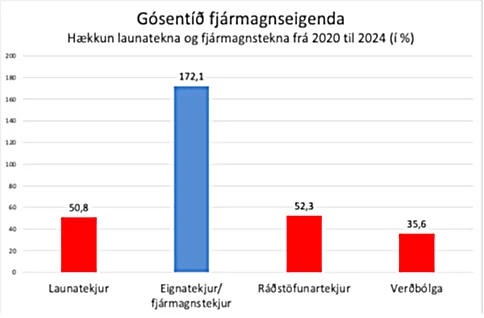
Let's examine how those revenues have grown in comparison with the public's wage earnings over the period from 2020 to 2024. The data comes from Statistics Iceland.

As the image shows, investment income/financial earnings have increased by 172% during this period while wage earnings rose by 50,8%. The investment incomes have, in other words, increased more than three times as much as the wage incomes. For comparison, combined inflation over the period (35,6%) and the increase in household disposable income (52,3%) are shown.


This reflects a great boom period among property‑rich people. Companies have given a lot, investments in securities as well. They are well‑established investors who in recent years have bought a lot of new apartments on the housing market (sometimes whole blocks) to rent out to tourists or others have profited greatly from the housing crisis which eats up the purchasing power of ordinary wage earners and tenants. And those who have been able to put a lot into savings accounts have grown well in the high‑interest environment of the Central Bank. Their interest earnings have increased rapidly due to unique factors of the capital markets.


The role of capital returns in inflation


Perhaps the Central Bank should look to this group that has the highest incomes in society and maintains high consumption and investments that drive up demand-pull inflation. It is not the low-wage workers or the indebted young people who are the main drivers of inflation. The bank's interest rate policy, however, bites most at those with lower incomes and debt – but spares those with higher incomes and more assets. It is a derived and unfair economic policy that also does not deliver sufficient results in the fight against inflation.


In the United States it is the case that the ten percent of the population with the highest incomes are responsible for about half of private consumption in that country. The same applies to the same proportion here in the country. If it is necessary to reduce private consumption to curb inflation, the most effective approach is to reduce the consumption of the higher‑income and wealthier, e.g., by raising taxes on capital income and the highest wages.


In the end, it is also right to note that those who have large capital earnings enjoy large tax advantages, due to lower taxation on capital earnings than on wages. They do not even pay any contribution to the municipalities from these earnings.


Here previously it was considered that people who were capable of working and providing housing for their families were entitled to tax benefits (e.g., in the form of interest subsidies). That was a long time ago. Now most of the tax benefits flow to capital owners who let the money work for them. Such an arrangement undermines work quality and encourages the exploitation of non‑beneficiaries.


The golden age of capital owners since 2020 is due both to a large increase in capital returns and the many tax privileges they enjoy. But above all, such benevolent activity of the state in favor of the wealthiest, which consists of lower taxation on capital income than on wages, is both unnecessary and unfair. In fact, it is harmful because it fuels inflation.


Stefán Ólafsson is a specialist at Efling and emeritus professor at the University of Iceland.

Eftir Freyr Efling 27. ágúst 2026
Efling’s offices open later than usual on the upcoming Friday, August 28, due to a staff meeting. The office opens at 10:00 that day instead of 9:00 as usual.
Eftir Freyr Efling 27. ágúst 2026
Skrifstofa Eflingar stéttarfélags opnar síðar en vant er næstkomandi föstudag, 28. ágúst, vegna starfsmannafundar. Skrifstofan opnar klukkan 10:00 þann dag í stað klukkan 9:00 líkt og vant er.

Eftir Freyr Efling 24. ágúst 2026
Efling Union is calling for nominations for delegates to the 47th Congress of the Icelandic Confederation of Labour (ASÍ), which will take place from 14–16 October. The Congress will be held at Hilton Reykjavík, Suðurlandsbraut 2, and will begin at 10:00 a.m. on Wednesday, 14 October. Efling has 56 delegate seats at the Congress. Full members of Efling may nominate themselves, and the union is now inviting nominations. Nominations can be submitted through the electronic form provided here and must be received by 4:00 p.m. on Monday, 31 August. Nominations for the ASÍ Congress 2026 Delegates will receive a daily allowance for the three days of the Congress. The allowance is ISK 18,100 per day, in accordance with the decision of the Travel Expenses Committee of the Ministry of Finance and Economic Affairs. Efling will reimburse delegates who lose wages as a result of attending the Congress, provided they submit supporting documentation to the union’s office. The ASÍ Congress is the Confederation's highest decision-making body. The Congress elects the President and Central Executive Committee, and considers amendments to the Confederation’s statutes as well as resolutions on its policies.  The ASÍ website contains all the main information about the Congress, including the agenda, Congress documents and draft resolutions.

Sýna fleiri fréttir