


Rent brake Reduces Inflation - Proposals from the Executive Board of Efling Union to the Government
Stjórn Efling stéttarfélags has sent the government its proposals on the introduction of rent control. The proposals have been send Kristrúnu Frostadóttur, the prime minister, Ragnari Þór Ingólfssyni, the minister of labour and housing, and to the committee members of the welfare committee of the Althing.
The introduction of a rent brake in the Icelandic rental market could help reduce inflation, inflation expectations and interest rates quickly. Rent levels in Iceland have risen far more than in neighbouring countries, making rent a distinct driver of inflation in Iceland.
Efling’s proposals include, among other things, a ban on monthly rent increases, annual increases linked to the Consumer Price Index excluding housing costs, clearer limits on the setting of market rents, and stronger oversight.
Efling points out that comparable actions have yielded good results abroad and especially refers to Denmark, where a temporary cap on rent increases has contributed to a faster decline in inflation than otherwise.
In Efling’s view, implementing a rent brake would be both a fast-acting anti-inflation measure and an important improvement in living standards for tenants, especially young and lower-income people. The union calls on the government to take immediate action.
Rent control reduces inflation
Proposals from the Executive Board of Efling Union to the Government
1. The Icelandic rental market is abnormal
In the Icelandic rental market there are fewer barriers to rent increases than in almost all neighboring countries. This has led to residential rent having risen much more in Iceland than anywhere in Europe. Rent has, for example, increased three times more in Iceland than in the other Nordic countries on average over the last decade.
Rent in Iceland has not only increased monthly, but the annual rent increase has been about three times higher than the rise in the Consumer Price Index of Statistics Iceland (VNV). Thus, rent prices have been a distinct driver of inflation in the country. This applies to both residential and commercial property rents.
Therefore, it is an extremely important issue for society and especially for workers to bring the regulation of the rental market here to a comparable level that is common in most industrialized countries. This could be a large and swift step in the fight to lower inflation, inflation expectations, and the country's interest rate.
2. Efling’s proposals
Efling proposes to the authorities that decisive and swift action be taken on these issues. Proposals Efling, which are based on the experience of OECD countries, address five important factors that everyone must deliver in order to achieve success. The proposals are as follows:
1. Ban monthly rent increases. Í Instead, annual increases would apply, e., at the start of the lease term (as is common elsewhere)
2. ÞThis provision bæði for úrent á íhousing and commercial premises
3. Annual rent increases on the general market shall not be greater than the corresponding increase in the consumer price index excluding housing. This will initially apply during the term of collective bargaining agreements (i.e., until 2028). By this reduce the interaction between housing market tightness and overall price levels.
4. Takmarkanir verði settar við ákvörðun leigu við upphaf eða endurnýjun leigusamnings, þannig að leiga sé ekki hærri en fyrir sambærilegt húsnæði á markaði á þeim tíma (þetta er svipað og tíðkast í Noregi, Danmörku, Svíþjóð, Þýskalandi og víðar). Hagstofan birti reglulega upphæð meðalleigu eftir tegundum húsnæðis og staðsetningu, sem verði leiðbeinandi viðmið við gerð leigusamninga.
5. Monitoring by HMS of market rent developments should be strengthened, and tenant consumer protections should also be reinforced.
The Minister of Social Affairs and Housing has outlined his plans to ban monthly rent increases and that is a good first step. But all the other steps also need to be taken fully to achieve sufficient progress in the fight against inflation and interest rate cuts. This is what is needed to bring the Icelandic rental market to a comparable level and is common in many neighboring countries. This is also a major wage issue for workers, especially the younger and lower‑income ones, who are generally more entrenched in rental housing than other social groups, with about 30% of the country's residents now living in rental housing.
3. Example of Denmark
When inflation rose from 1.9% to about 8% in Denmark, following the Russian invasion of Ukraine in 2022, the government of Mettu Fredriksen temporarily capped annual rent increases at 4%, or about half of the inflation rate at the time. This lasted for 2 years. Inflation fell to about 3% straight the following year. Rent control can thus be a very swift and powerful brake on general price increases.
4. General arguments and data
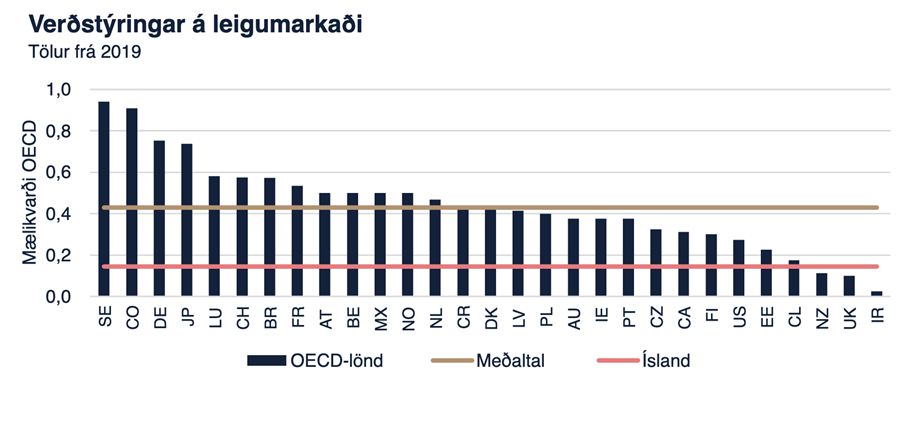
The Icelandic rental market is freer of restrictions on rent increases than is typical in neighboring countries. Only 3 of the 29 OECD member states have fewer limits on rent increases than Iceland (see Figure 1 in the Appendix). Moreover, the United States places greater obstacles on rent increases than Iceland. Iceland is, in fact, rated low in governmental disengagement from the rental market.
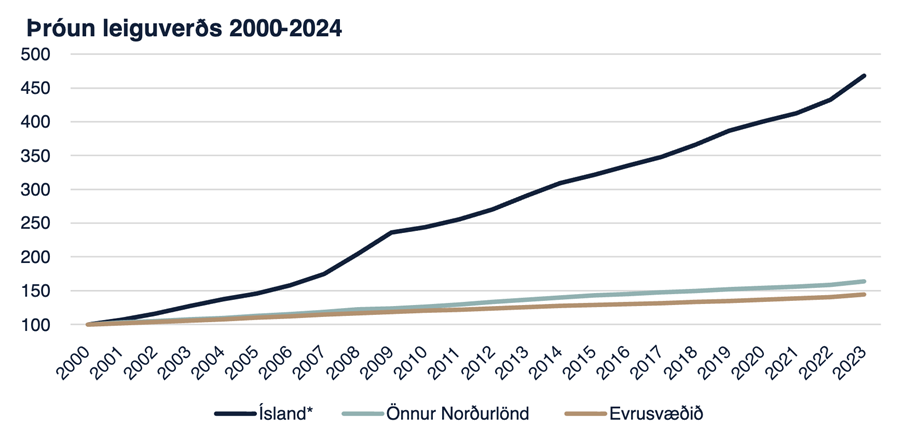
Therefore it has been unusually easy for Icelandic landlords to raise rent beyond what has been the case in the neighboring countries, both for apartments and commercial premises. As we expect, this has resulted in much larger rent increases here in the country (see figure 2 in the Appendix).
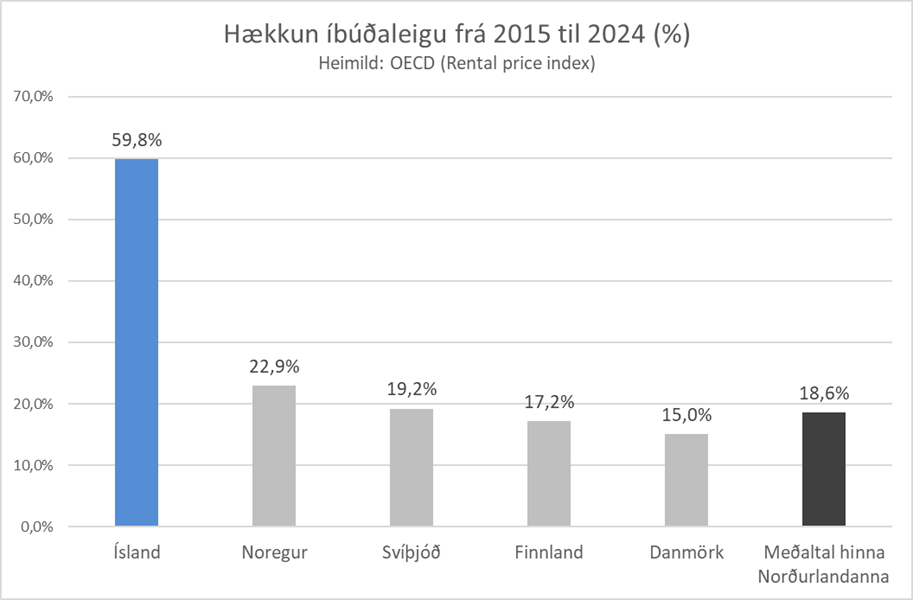
Apartment rent has, for example, increased three times more in Iceland than in the other Nordic countries over the period from 2015 to 2024 (see figure 3 in the Appendix). The rent here has risen far beyond general price increases in consumer goods (the VNV index) and therefore rent is generally an independent driver of inflation.
Monthly rent increases mean that rent is leading in inflationary pressure (average wages and public fees generally do not increase monthly, but annually). Then the rent increase feeds into the inflation measurement – and then becomes an occasion for further rent hikes, in an inflation‑driven feedback loop of increases. Periodic increases in the rental of commercial premises to companies go directly into the price level.
This is an entirely unacceptable arrangement, which plays a major role in the three‑year inflation here in the country and the high interest rate.
The main way of the labor movement to protect wage earners against excessive rent and housing price increases, as well as price hikes on necessities, is to try to keep wages in line with these cost increases. If rent and housing prices rise far beyond the purchasing power of wage earners, it leads to larger wage increases than otherwise in the future.
The Broad Alliance of Employee Unions attempted in the 2024 wage agreements to achieve a national pact on lowering inflation and interest rates, with a modest wage increase for four years, in fact with smaller annual increases than the inflation at the start of the bargaining period.
Now it is up to landlords to show similar restraint to reduce inflationary pressure from the rental market. Landlords earn in two ways: through excessive rent increases and through unusually large increases in property prices, which increase the equity of landlords in rental apartments.
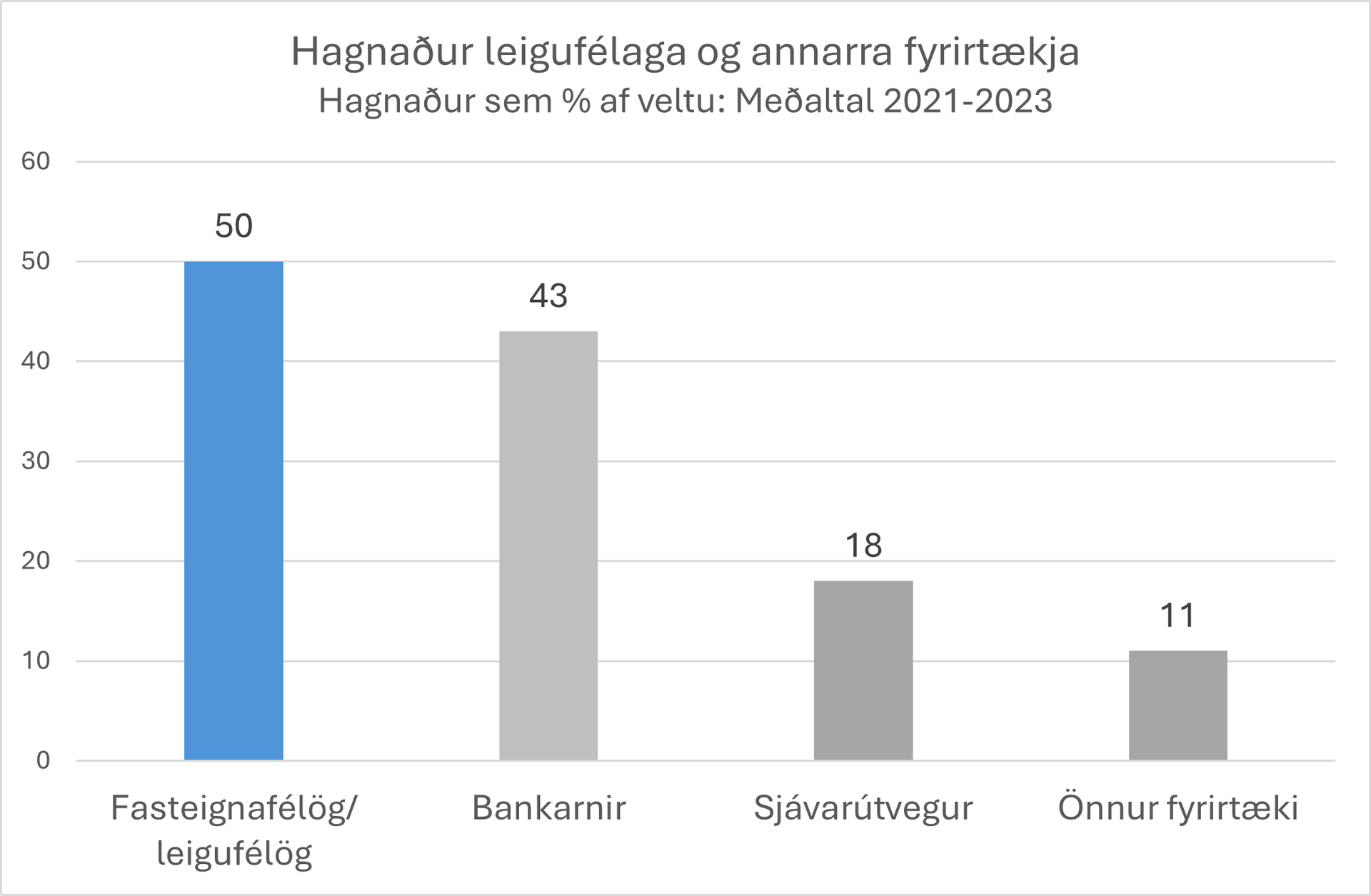
This is a double profit trap. Landlords have therefore made a huge profit from their activities in recent years. Rental associations in the general market have even had a higher profit margin on turnover than the banks (see figure 5 in the Appendix).
The same control would also need to apply to housing prices and other essential goods, as well as to public fees.
National agreement to quickly achieve the Central Bank's target of 2.5% inflation should then mean that landlords, property sellers, public parties and sellers of goods and services limit their annual increases to 2.5% out of the contract period until 2028. Because of a great risk of a further increase in import prices in the near future, however, increases could be limited to the consumer price index without a housing component during the period. This should ensure adequate operating income for landlords, i.e., in line with other activities in the business economy.
What could a rent brake achieve in Iceland now?
After years of inflation in both rent and housing prices over the past 10-15 years, the price level for housing in Iceland has become too high, whether for purchase or rent. Young people have to incur debt at an alarming rate to acquire a home and tenants are increasingly finding it harder to save for a down payment on a home. The number of those who can manage the repayment burden of necessary loans is steadily decreasing, especially after banks have recently tightened mortgage loan limits even further.
Direct reductions in these housing costs, which are caused, among other things, by the interaction of supply and demand, would have to occur. But it takes longer.
However, it is now possible to grab the reins and curb the runaway rental market to begin with. This would ensure that the situation does not continue to deteriorate, but would improve with slower adjustment. Inflation pressure would decrease. This would entail a wage increase for tenants in general and especially for young people with lower and middle incomes.
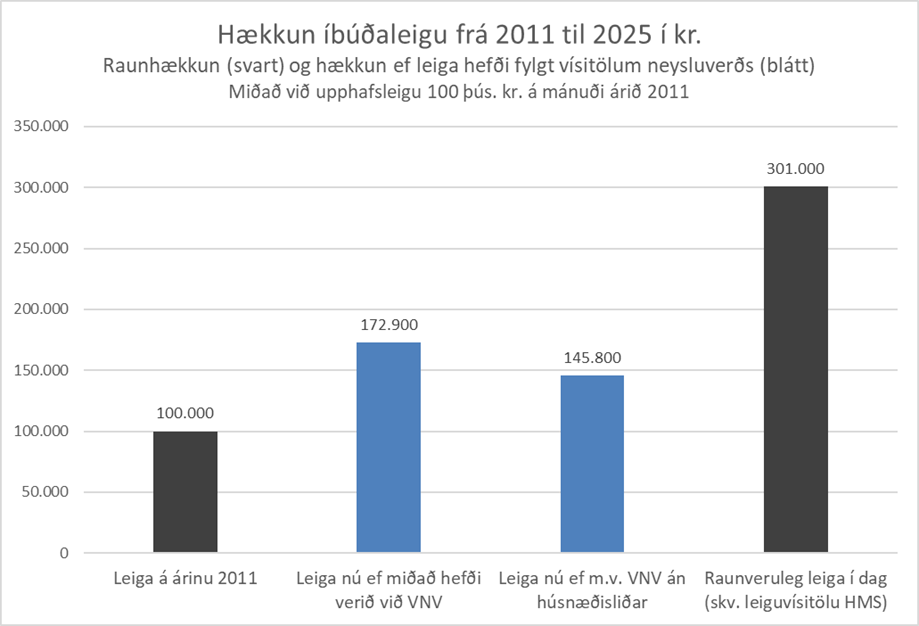
In figure 4 in the appendix you can see what the impact of the measures that Efling currently proposes would have been if they had been applied to rent prices from 2011 to 2025.
It states that the premises that were rented at 100 thousand kr. per month in the year 2011 are today rented at about 300 thousand kronur (according to the projection based on the HMS rent index). The rent has tripled.
If rent had only increased with an annual link to the Statistics Iceland price index (VNV) then the rent for comparable housing today would be about 173 thousand crowns per month. If it had been linked to the price index without the housing component (which would be most reasonable) then the rent for the same housing would be about 146 thousand crowns today, not about 300 thousand crowns. The rent would be about half as high.
Such restrictions on rent increases would stop the independent rent‑increase effects on inflation, quickly lower inflation expectations and strengthen stability in the economy.
This would also be a major advantage for tenants, who now make up a high 30% of the country's population and are often the lowest earners.
Implementation of a group rent control, as suggested by Efling, costs the state no additional expenses, but it can improve the income of the public sector which is often in the position of a tenant. It is possible to implement rent control quickly, as the experience of Denmark shows. Efling therefore urges the authorities to adopt the rent control promptly and properly.
______________________________________________________________________________
Appendix:
Data on regulation of the rental market and rent increases